1 in 5 pupils in England now has an identified special educational need (DfE, 2026). But the group that keeps SENCOs awake at night is mostly not on that register. It sits underneath it and between its tiers: the middle group. Every SENCO knows these children by name.
Three overlapping sets
The middle group is defined by two facts, not by a diagnosis. There is a real difficulty with attention or executive function: the mental machinery of focusing, holding things in mind, planning and finishing. And there is a system that either will not move for the child, or will not move quickly enough.
- The never-identified
- Their difficulties have simply not been noticed.
- The parked
- Recognised at SEN support, where the school must help, but where the need itself has often never been measured.
- The waiting
- Already in the referral queue. The system will move for them, just not soon: children wait an average of 27 months for a neurodevelopmental diagnosis, and 41% wait more than two years (Children's Commissioner for England, 2024).
Why the gate misses them
The referral route begins with adult suspicion, and suspicion is biased. In one study across 10 countries, girls made up just 16% of ADHD referrals despite similar levels of impairment (Novik et al., 2006), largely because girls with attention difficulties tend to daydream rather than disrupt. And 42% of teachers report not knowing how to address ADHD-type needs in the classroom (ADHD Foundation, 2022).
A gate that opens only for the children an adult happened to notice was never going to be fair. The children it misses are, for the most part, never measured by anyone.
What changes when every child is measured
The answer to a biased gate is not a better gate. It is measuring everyone.
When a whole cohort completes the same objective assessment, the quiet daydreamer and the disruptive boy get the same look. The children nobody referred get flagged. And the children in the queue stop waiting empty-handed: the school has evidence to act on now, and to support the referral when it comes.
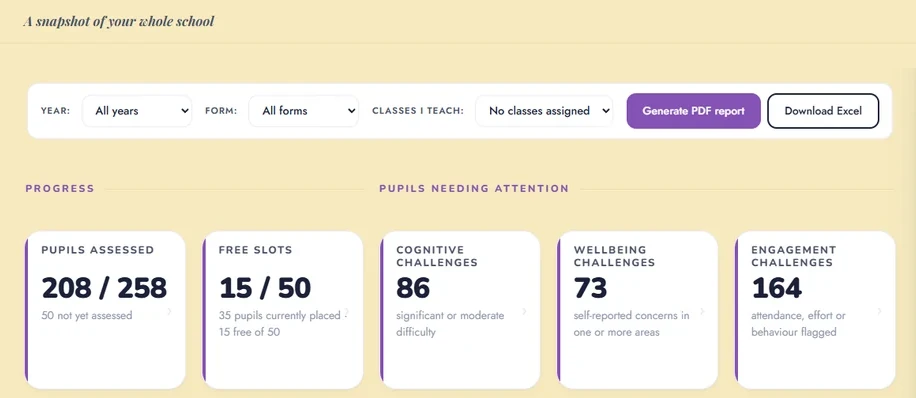
That is the thinking behind Veyra: Mind Skills Check. One lesson, every pupil measured the same way, and a class picture with strategies attached. For the children who need more, an individual profile and action plan: strengths first, difficulties explained. Not a diagnosis, and never a label. A way of seeing the children the system has been walking past.